
The northern corner of Yellowstone is the one part of the park you can drive in any month. The road from the North Entrance at Gardiner through Mammoth Hot Springs, Tower Junction and the Lamar Valley to Cooke City stays open to ordinary cars all year, while every other park road closes to cars at the end of October. That makes this two-day route the best way to see Yellowstone from Montana in summer, and the only way to see it by car in winter.
Day 1 covers the terraces and historic fort at Mammoth and the waterfalls and back roads beyond it. Day 2 starts before dawn in the Lamar Valley, where bison, elk and, with luck, wolves are easiest to see, and runs on to the Northeast Entrance and Cooke City. Gardiner to Cooke City is about 56 miles, roughly two hours without stops. Note the state line: Gardiner and Cooke City are in Montana, but Mammoth and the Lamar Valley are just across it in Wyoming. Prices and rules are the 2026 ones, checked in October 2026.
Before you go
- Entrance fee. $35 per private vehicle, valid seven days, payable by cash or card at the North Entrance. Non-US residents aged 16 and over pay an extra $100 each unless the car enters on an annual pass; the $70 Yellowstone annual pass is for US citizens and residents, so foreign visitors should buy the $250 America the Beautiful nonresident pass. Details: Montana park passes and permits.
- Fuel and food. Fill up in Gardiner. In winter there are no services between Mammoth and Cooke City, about 50 miles, and the summer store, lodge and staffed gas station at Tower-Roosevelt close in early September.
- No signal. Phone coverage inside the park is minimal and usually absent in the Lamar Valley. Download maps before you leave Gardiner.
- Binoculars. Wildlife in the Lamar Valley is often a mile away. Bring binoculars at least; scopes can be rented in Gardiner and Silver Gate.
- Construction in 2026. Expect single-lane delays of up to 15 minutes at the Gardner River High Bridge just past Mammoth (until late October) and up to 30 minutes at the Yellowstone River Bridge east of Tower Junction (through November). Oversize vehicles cannot cross the High Bridge.
Day 1, morning — the Roosevelt Arch and the road to Mammoth
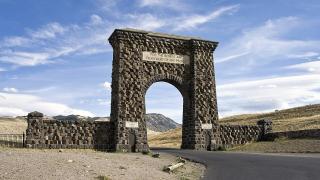
Start at the Roosevelt Arch on the edge of Gardiner, the stone gateway whose cornerstone Theodore Roosevelt laid on April 24, 1903. It stands outside the fee station, so you can walk up to it and read its inscription, "For the Benefit and Enjoyment of the People", without paying.
 The Roosevelt Arch at Gardiner, Yellowstone's original entrance. Image: Yellowstone National Park, Public domain, via Wikimedia Commons.
The road to Mammoth climbs about 5 miles, crossing the 45th parallel and the Wyoming line on the way. Since the June 2022 flood washed out the old road through the Gardner River canyon, traffic has used the paved former Old Gardiner Road, a temporary route built in about four months. In September 2026 the park approved a permanent replacement, with work that could start as early as 2027, so expect construction delays here in coming summers. The Boiling River, once a popular legal soaking spot along this stretch, has been closed since the flood and has no reopening date.
Day 1, mid-morning — Mammoth Hot Springs terraces
Yellowstone's northern headquarters sits beside a hillside of travertine terraces built by hot water rising through limestone. The terraces change constantly, sometimes within a day, so which springs are flowing varies from season to season: ask at the visitor center. About 1.75 miles of boardwalks climb from Liberty Cap and Palette Spring at the bottom to Canary Spring and the upper terraces. The climb includes several hundred stairs; the park rates it strenuous. The tops of Canary and Palette springs can be reached without stairs from the upper parking area when there is no snow.
 Canary Spring, on the upper boardwalks of the Mammoth terraces. Image: Yellowstone National Park, Public domain, via Wikimedia Commons.
 Steaming travertine on the Mammoth terraces. Image: Rhododendrites, CC BY-SA 4.0, via Wikimedia Commons.
Allow 30 to 90 minutes. Stay on the boardwalks: more than 20 people have died in Yellowstone after entering or falling into hot springs, and the travertine breaks easily. In summer you can also drive the one-way Upper Terrace Drive, about 1 to 1.5 miles; it is closed to trailers, buses and RVs.
Day 1, late morning — Fort Yellowstone and the Albright Visitor Center
Below the terraces, the stone and timber buildings of Fort Yellowstone date from 1891 to 1913, when the US Army ran the park. They now house park offices and staff, and a self-guided walking route explains them. The Albright Visitor Center, in the former bachelor officers' quarters, is the only Yellowstone visitor center open all year.
 One of the Fort Yellowstone buildings, built when the Army ran the park. Image: Acroterion, CC BY-SA 4.0, via Wikimedia Commons.
 The Albright Visitor Center, the former bachelor officers' quarters. Image: Yellowstone National Park from Yellowstone NP, USA, Public domain, via Wikimedia Commons.
Elk live around Mammoth all year and graze on the lawns between the buildings. They are not tame: the park reports that visitors are chased, trapped and sometimes injured by elk every year, especially during the autumn rut and the spring calving season. Keep at least 25 yards away.
Mammoth has the only year-round general store and campground in the park, a medical clinic and the Mammoth Hot Springs Hotel. The hotel, renovated and reopened in 2019, now stays open from late April straight through to early March; its dining room ran from April 24, 2026 to March 8, 2027.
Day 1, afternoon — Undine Falls, Wraith Falls and the Blacktail Plateau
East of Mammoth the road toward Tower Junction passes Undine Falls, a 60-foot fall visible from a roadside pullout about 4 miles out. A little further, a half-mile trail leads to Wraith Falls, a 79-foot cascade over a rock face. The surrounding Blacktail bear management area closes to off-trail travel each spring, but the Wraith Falls trail stays open.
 Undine Falls, a short stop beside the road east of Mammoth. Image: Daniel Mayer, CC BY-SA 3.0, via Wikimedia Commons.
In summer and early autumn, the unpaved Blacktail Plateau Drive leaves the main road for a one-way, 6-mile loop through forest and meadow; it opens later than other roads, usually in July, because it runs through bear habitat, and is closed to RVs and trailers. In winter it becomes a ski trail.
 The unpaved Blacktail Plateau Drive, open to cars only in summer and early autumn. Image: Yellowstone National Park from Yellowstone NP, USA, Public domain, via Wikimedia Commons.
Tower Junction is 18 miles from Mammoth, about 45 minutes. In summer the Roosevelt Lodge area has a dining room, a store and horseback rides, open from early June to early September. Return to Gardiner for the night, or stay at Mammoth.
Day 2, before dawn — the Lamar Valley
Be in the Lamar Valley by sunrise. From Gardiner it is about 33 miles to the Lamar Buffalo Ranch, roughly an hour on an empty road, so leave 75 to 90 minutes before sunrise. The valley, in Wyoming, is one of the main summer grounds for bison and elk, and the park calls its northern range one of the best places in the world to watch wolves. Grizzly bears, pronghorn and coyotes are also seen here.
Wolves were reintroduced in 1995 and 1996. At the end of 2025 the park counted 84 wolves in seven packs, down from 108 a year earlier, probably because of disease, so sightings are never guaranteed. The best clue is a line of parked cars and scopes at a pullout. Pull fully off the road, walk over quietly and ask what people are watching; many will offer a look.
 Wolf watchers with a spotting scope in the Lamar Valley. Image: Neal Herbert, Public domain, via Wikimedia Commons.
The rules are strict and enforced: stay at least 100 yards from bears and wolves and 25 yards from bison, elk and all other animals. Bison have injured more people in Yellowstone than any other animal and can run three times faster than a person. If bison block the road, wait in your car; do not honk or push through. Never stop in the travel lane, even for a moment.
Day 2, morning — Slough Creek, Soda Butte and Pebble Creek
The pullouts near the Slough Creek road junction, west of the Buffalo Ranch, are classic wolf-watching spots. The Lamar Buffalo Ranch itself, where bison were bred back from near extinction, is a Yellowstone Forever field campus with no public facilities; you see it from the road.
 Slough Creek, one of the classic wolf-watching areas. Image: Rhododendrites, CC BY-SA 4.0, via Wikimedia Commons.
Further east, beside the road and Soda Butte Creek, Soda Butte is a dormant travertine cone made of the same mineral as the Mammoth terraces, with only a little hot water and hydrogen sulfide still seeping out. Between Pebble Creek and the Northeast Entrance, the park says, is where moose are most often seen. Pebble Creek campground is closed until further notice after the 2022 flood.
 Soda Butte, a dormant travertine cone beside the road. Image: HaSt, CC BY-SA 4.0, via Wikimedia Commons.
Day 2, midday — Northeast Entrance and Cooke City
The Northeast Entrance is 18 miles from the Buffalo Ranch, and Cooke City, back in Montana, 4 miles beyond it, past the hamlet of Silver Gate. Cooke City sits at about 7,600 feet and gets around 200 inches of snow a year. In summer the Beartooth Highway continues east over the mountains to Red Lodge; it closed for the 2026 season on October 9. In winter the road ends a few miles east of Cooke City, and the town becomes a snowmobile base. Either way, you return to Gardiner the way you came, about two hours, watching the valley again in the afternoon light.
Doing it in winter
From mid-December to early March this route works as a winter trip, and the Lamar Valley is at its best for wolves against the snow.
- Roads. The Gardiner to Cooke City road is plowed but rarely bare: expect packed snow and ice. Temperatures between 0 and 20°F are normal and sub-zero nights common. The park can close the road without notice in storms. It publishes no chain rule for this road, but winter tires and traction devices are strongly recommended. Montana road conditions: winter driving in Montana.
- Mammoth. The boardwalks are open but most are not maintained in winter; wear traction aids. Upper Terrace Drive becomes a groomed ski and snowshoe loop of about 1.5 miles. The Mammoth Hotel and dining room stay open; cabins without hot tubs close for winter.
- Tours from Mammoth (2026/27). Snowcoaches leave Mammoth for Old Faithful daily from December 16, 2026 ($179.45 adult); a guided Lamar Valley wildlife tour runs Thursdays, Saturdays and Mondays from December 17 to March 6 ($236.28 adult, lunch included).
- Services. Nothing is open between Mammoth and Cooke City. Fill up in Gardiner, carry food, water, warm clothes and a blanket, and tell someone your plan.
 Hoar frost on the Mammoth terraces in winter. Image: Yellowstone National Park, Public domain, via Wikimedia Commons.
The days at a glance
| Day | Stop | Allow | Book ahead? |
|---|---|---|---|
| 1 | Roosevelt Arch | 20 min | No |
| 1 | Mammoth Hot Springs terraces | 1–1.5 h | No |
| 1 | Fort Yellowstone and Albright Visitor Center | 1 h | No |
| 1 | Undine Falls, Wraith Falls, Blacktail Plateau Drive (summer) | 2 h | No |
| 2 | Lamar Valley at dawn | 3 h | No; winter tour from Mammoth, yes |
| 2 | Slough Creek, Soda Butte, Pebble Creek | 1.5 h | No |
| 2 | Northeast Entrance and Cooke City, return to Gardiner | 3 h | No |
Practical notes
- Getting to Gardiner. From Bozeman it is about 78 miles, an hour and a half, by I-90 to Livingston and US-89 through Paradise Valley; US-89 is plowed all year. From Bozeman Yellowstone International Airport it is about 88 miles.
- Where to stay. Gardiner is a year-round town, though some motels close in winter. Mammoth Hot Springs Hotel is the only lodging inside the park on this route in winter. Cooke City and Silver Gate are small and partly seasonal.
- Wildlife watching. Best at dawn and dusk. Use pullouts only. Drones are banned in all national parks. More in wildlife watching in Montana.
- Common mistakes. Rangers and local guides list the same ones: stopping in the road for animals, getting too close to elk at Mammoth or bison on the road, arriving in the Lamar Valley at midday, setting off without fuel or food, and expecting the Boiling River to be open.
Prices and rules are as published for 2026 and the 2026/27 winter season, checked in October 2026.


