Winter driving in Montana is common, and conditions change quickly. Mountain passes on I-90 and US-2 can have packed snow and ice from October to May. On the eastern plains, wind can blow snow off the fields and cut visibility to almost nothing without any new snowfall. Several famous summer roads close completely. In 2026 both Glacier's Going-to-the-Sun Road and the Beartooth Highway closed for snow on October 9.
This guide covers checking conditions through Montana 511, the state's rules on studded tires and traction devices, and which scenic roads close each winter. It also explains the one road into Yellowstone that stays open to cars, how ground blizzards affect the plains, and what to carry in your vehicle. Conditions change by the hour, so the official sources linked here matter more than any guide.
Check conditions with Montana 511
The Montana Department of Transportation (MDT) runs the state's 511 traveler information service. It reports:
- road surface conditions
- closures
- road work
- chain and traction requirements
- commercial vehicle restrictions
You can reach it three ways:
- Phone: dial 511 inside Montana, or 1-800-226-7623 from outside the state.
- Web: the 511MT map at 511mt.net shows conditions, closures and road cameras.
- App: MDT's 511 app is available for Android and iPhone.
The reports cover interstates, US routes, state highways and some secondary roads, but not county roads or city streets. Road conditions come from maintenance crews' observations and are not live, so check again before each leg of a winter drive.
Tires, chains and traction rules
- Studded tires are legal in Montana only from October 1 to May 31 (MCA 61-9-406). You can carry one studded tire as a spare at any time.
- Heavy trucks: from October 1 to April 30, anyone driving a truck of 26,001 lb GVW or more and towing a trailer must carry approved traction devices on designated mountain passes (MCA 61-9-436). Four-wheel-drive vehicles are exempt.
- When MDT posts chain or traction requirements on a pass, obey the signs. Vehicles towing trailers must then chain the drive wheels of one axle, and MDT accepts textile "snow socks" as an alternative to chains.
- Rental cars in Montana usually come with all-season tires, not winter tires. Ask about winter tires or all-wheel drive when you book, and read the contract's rules on fitting chains.
Passes that often need care include Homestake Pass on I-90 east of Butte, Bozeman Pass ("Bozeman Hill") on I-90 between Bozeman and Livingston, MacDonald Pass on US-12 west of Helena, Marias Pass on US-2 south of Glacier, and Lookout Pass on I-90 at the Idaho line.
Roads that close for winter
| Road | Winter status | 2026 notes |
|---|---|---|
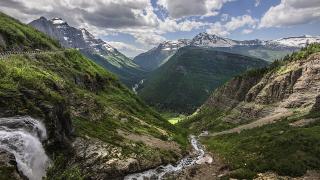
| Going-to-the-Sun Road, alpine section (Glacier) | Closed to vehicles; lower sections stay open all year | Fully open June 22; alpine section closed for snow October 9 between Avalanche and Jackson Glacier Overlook |
| Beartooth Highway, US-212 (Red Lodge to Cooke City) | Closed for winter | Closed for the season October 9, 2026, four days early |
| Chief Joseph Scenic Byway, WY-296 | Projected 2026 season May 22 to October 12; 9 mi from Cooke City to Pilot Creek closed to wheeled vehicles in winter | Closes to wheeled vehicles in early November |
| Yellowstone interior roads | Closed to cars; snowmobile and snowcoach only in winter | Oversnow season December 15, 2026 to mid-March 2027 |
| Gardiner to Cooke City through Yellowstone | Open to cars all year | Ends at Cooke City in winter |
Going-to-the-Sun Road has no set opening date. Plowing usually takes until late June or early July; the average full opening since 2010 is about June 26. Its full season normally ends on the third Monday of October, but weather can close sections at any time. For Glacier road alerts, text GNPROADS to 333111.
The Beartooth Highway usually runs from Memorial Day weekend to mid-October. Its high point, Beartooth Pass (10,947 ft), is in Wyoming.
Yellowstone in winter: the Gardiner–Cooke City road
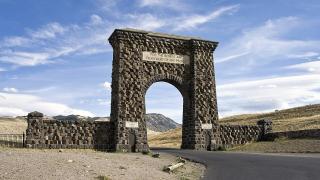
The only road in Yellowstone that stays open to ordinary cars all winter runs from the North Entrance at Gardiner, past the Roosevelt Arch, Mammoth Hot Springs and Tower Junction, and through Lamar Valley to the Northeast Entrance and Cooke City. It is about 61 mi and takes around two hours in good conditions.
- In winter it is a dead end. The Beartooth Highway is closed, and the 9 mi of road east of Cooke City to Pilot Creek is closed to wheeled vehicles. You have to return the way you came.
- For 2026, the NPS lists October 31 as the closing date for most other park roads to regular vehicles.
- From December 15, 2026, groomed roads open to guided snowmobiles and snowcoaches, with different sections closing between March 7 and March 15, 2027.
- West Yellowstone is reached by road all winter from Bozeman, but its park entrance is open only to oversnow vehicles.
- Yellowstone's recorded road information line is (307) 344-2117.
Lamar Valley is one of the best places in the US to watch wolves in winter. Expect slow traffic around wildlife-watching pull-outs and drive with care on packed snow.
Ground blizzards on the plains
East of the Rockies, the main danger is often wind rather than snowfall. A ground blizzard forms when strong wind lifts snow that is already on the ground. Visibility can drop to near zero under a clear sky, and drifts can build on a road that was clear an hour earlier.
- MDT closes interstates when conditions become too dangerous. Past examples include I-90 between Livingston and Big Timber for blowing snow and whiteouts, and I-94 from Billings to the North Dakota line during heavy snow in April 2022.
- A storm on I-90 over Bozeman Hill once stranded hundreds of motorists and kept the road closed for about 12 hours.
- On the Hi-Line (US-2) and the roads around Glasgow and Miles City, towns can be 70–100 mi apart. Don't set out when a blizzard or high-wind warning is posted.
- If visibility collapses, slow down, turn on your low beams, and pull fully off the road only where you can. Don't stop in a traffic lane.
- If you get stuck, stay with your vehicle. It is easier to find than a person on foot.
What to carry in winter
- A full tank, refilled at half. Running the engine is your heat if you are stranded.
- Warm layers, a hat, gloves and boots for every passenger, even on a short drive.
- Blankets or a sleeping bag, water and high-energy food.
- An ice scraper, a snow brush and a small shovel.
- Traction aids: sand or kitty litter, and chains or snow socks that fit your tires.
- A phone charger and a paper map. Mobile coverage is patchy in the mountains and on the plains.
- A flashlight, a first-aid kit and jumper cables.
Animals are also harder to see in winter. Montana has the second-highest odds of animal collisions in the US (1 in 54), and deer and elk gather on plowed roads and in valley bottoms.
Before you go
- Check 511mt.net or dial 511 before every winter leg, not just in the morning.
- Confirm that studded tires are only fitted between October 1 and May 31, and ask your rental company about winter tires or all-wheel drive.
- Don't plan winter routes over the Beartooth, Going-to-the-Sun Road or Yellowstone's interior. Use the Gardiner–Cooke City road or a guided oversnow trip.
- Pack the winter kit above and tell someone your route and arrival time.
- Delay the drive if a blizzard or high-wind warning is posted for your route.
Details checked October 2026.