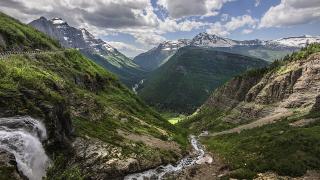
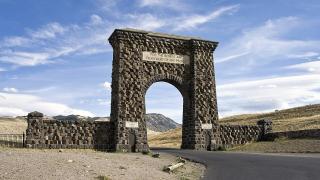
Most trips to Montana go without a hitch, but the risks that do come up are particular to the place: grizzly bears across much of the western half of the state, wildfire smoke in late summer, passes high enough to cause altitude headaches, rivers fed by snowmelt, and long stretches of road with no phone signal. None of these should stop you from going. Each one needs a little planning before you set out, not after.
This guide covers the rules and tools that matter in 2026: where food storage orders apply, how far to stay from wildlife, where to check smoke and fire information, which hospitals handle serious injuries, and what to do when 911 won't connect. For park-specific detail, see our pages on Glacier National Park and Yellowstone National Park.
Bears: grizzly range, bear spray and the distance rules
Grizzlies are no longer confined to Glacier and Yellowstone. An Interagency Grizzly Bear Committee report published in late 2025 put the occupied grizzly range in Montana at about 34,048 square miles, and the Northern Continental Divide population (Glacier, the Bob Marshall and the Rocky Mountain Front) grew its range by about 12% between 2022 and 2024. FWP has confirmed grizzlies on the prairie around Lewistown and east of Bozeman. Treat any forested or brushy country west of Billings as bear country.
- Distance: in Glacier and Yellowstone it is illegal to approach within 100 yards (91 m) of bears or wolves, and you must stay 25 yards (23 m) from all other wildlife, including bison, elk and moose.
- Bear spray: Yellowstone advises that each person in a group carries a can where it can be reached quickly, not inside a pack, and sprays when a charging bear is 30-60 feet away. It is a deterrent, not a repellent, so never spray it on gear or skin. Cans can burst above 120 °F, so don't leave them on a dashboard.
- Flying in: TSA lists bear spray as not allowed in carry-on or checked bags. Buy it after you land.
- On the trail: hike in groups, make noise near streams and blind corners, and keep children close. Bears are most active at dawn and dusk.
Food storage orders on public land
Food storage is a legal requirement in much of western Montana, not just good practice.
- Glacier National Park: food, cookware (clean or not), food containers and trash must be in a vehicle, a food locker or hung whenever they are not in use, day and night. Nothing goes in pit toilets.
- Northern Continental Divide order (R1-2023-02): covers the Flathead, Lolo, Kootenai and Helena-Lewis and Clark national forests plus part of the Beaverhead-Deerlodge, every year from March 1 to December 31, through 2028. Unattended food, garbage and pet or livestock feed must be stored bear-resistant.
- Custer Gallatin National Forest: the order was reinstated on March 1, 2026 for the Bozeman, Hebgen Lake, Gardiner, Yellowstone and Beartooth districts and runs to December 1, 2026. Acceptable storage is a hard-sided vehicle, an approved bear-resistant container, or a hang at least 10 feet up and 4 feet from any tree or pole.
- Crazy Mountains: a separate year-round order has applied since April 2025.
Approved containers are listed by the Interagency Grizzly Bear Committee at igbconline.org. Montana law (MCA 87-6-216) also makes it illegal to feed deer, elk, bears or mountain lions, with fines of $50 to $1,000.
Wildfire smoke and fire information
Fire season usually runs from July into September, and smoke from fires in Idaho, Washington, Oregon or Canada can settle over western valleys for days. On August 7, 2026, Missoula County's air was rated "Unhealthy" while much of eastern Montana stayed in the Good to Moderate range, so conditions can differ sharply across the state.
Where to check:
- Montana DEQ "Today's Air" (linked from deq.mt.gov/air): near-real-time AQI and PM2.5 readings from state monitors, plus county Air Quality Alerts.
- EPA AirNow Fire and Smoke Map (fire.airnow.gov): monitors, low-cost sensors and smoke plumes on one map.
- InciWeb (inciweb.wildfire.gov): incident pages for large fires, including closures and evacuation notices.
- Park alerts on nps.gov for Glacier and Yellowstone, which list fire-related trail and road closures.
Health officials advise children, older adults and people with heart or lung disease to limit prolonged exertion when air is unhealthy. On smoky days, swap a long hike for a museum, or drive to whichever side of the Continental Divide the wind favors.
Altitude, cold water and ticks
Altitude
Many popular spots are high: West Yellowstone sits at about 6,667 ft, Logan Pass at 6,646 ft, and the top of the Beartooth Highway at 10,947 ft (just across the line in Wyoming). The CDC says unacclimatized travelers sleeping at 8,000 ft or higher are at risk of altitude illness, usually a headache with tiredness or nausea 2-12 hours after arrival. Drink water, go easy on alcohol for the first 48 hours, and descend if symptoms worsen at rest.
Cold water
Snowmelt keeps rivers and lakes cold well into summer; Flathead Lake was still in the 50s °F in mid-June in past seasons. FWP warns that water below 70 °F can cool a swimmer enough to cause collapse and drowning. In Montana, children under 12 must wear a life jacket on a moving boat, and every person on a vessel, including paddleboards, must have one on board. Spring runoff (roughly May and June) makes rivers fast and full of debris.
Ticks
The Rocky Mountain wood tick is most active from late March to early July. It can carry Rocky Mountain spotted fever, first studied in the Bitterroot Valley around Hamilton, and Colorado tick fever. Check yourself and children every evening, and see a doctor if fever, headache or a rash follows a bite.
Hospitals and trauma centers
Montana's Department of Public Health and Human Services designates trauma hospitals by level. The November 2025 list includes:
| Town | Hospital | State designation |
|---|---|---|
| Billings | Billings Clinic; St. Vincent's Healthcare | ACS Level 1 / Comprehensive |
| Great Falls | Benefis Healthcare | ACS Level 2 / Regional |
| Missoula | Providence St. Patrick Hospital | ACS Level 2 / Regional |
| Bozeman | Bozeman Health | ACS Level 3 / Area |
| Butte | St. James Healthcare | ACS Level 3 / Area |
| Helena | St. Peter's Hospital | Area Trauma Hospital |
| Kalispell | Logan Health Kalispell | Community Trauma Hospital |
Smaller towns have community hospitals or trauma-receiving facilities, including Logan Health Whitefish, Livingston Healthcare, Big Sky Medical Center, Beartooth Billings Clinic in Red Lodge, Madison Valley Medical Center in Ennis, Frances Mahon Deaconess in Glasgow and Holy Rosary in Miles City. From the remote parts of Glacier or the Beartooths, expect a long drive or an air ambulance to reach a major center.
911 when there is no signal
Dial 911 for police, fire, ambulance or search and rescue. Coverage is the problem: Glacier says to expect no reception at Logan Pass, Many Glacier, Two Medicine or along US-2 on the park's southern edge, and Yellowstone describes cell service as "extremely limited".
- Text to 911 works in many Montana counties when a call won't connect; if it isn't available you get an automatic bounce-back message.
- Call boxes: on the Beartooth Highway, Vista Point, about 19 miles south of Red Lodge, has an emergency call box linked to Carbon County dispatch.
- Satellite SOS: iPhone 14 and later can text emergency services by satellite in the US with a clear view of the sky; several recent Android phones offer similar features. Our cell coverage guide has the details.
- Tell someone your plan and your expected return time before any hike or back-road drive.
Before you go
- Buy bear spray on arrival and carry it where you can reach it.
- Check whether a food storage order covers your campsite or trailhead.
- Look at DEQ Today's Air and the AirNow map before planning a long outdoor day in summer.
- Pack layers and water for high passes, even in August.
- Do a tick check every evening between March and July.
- Note the nearest hospital and save your route offline.
- Leave a trip plan with someone at home.
Details checked October 2026.