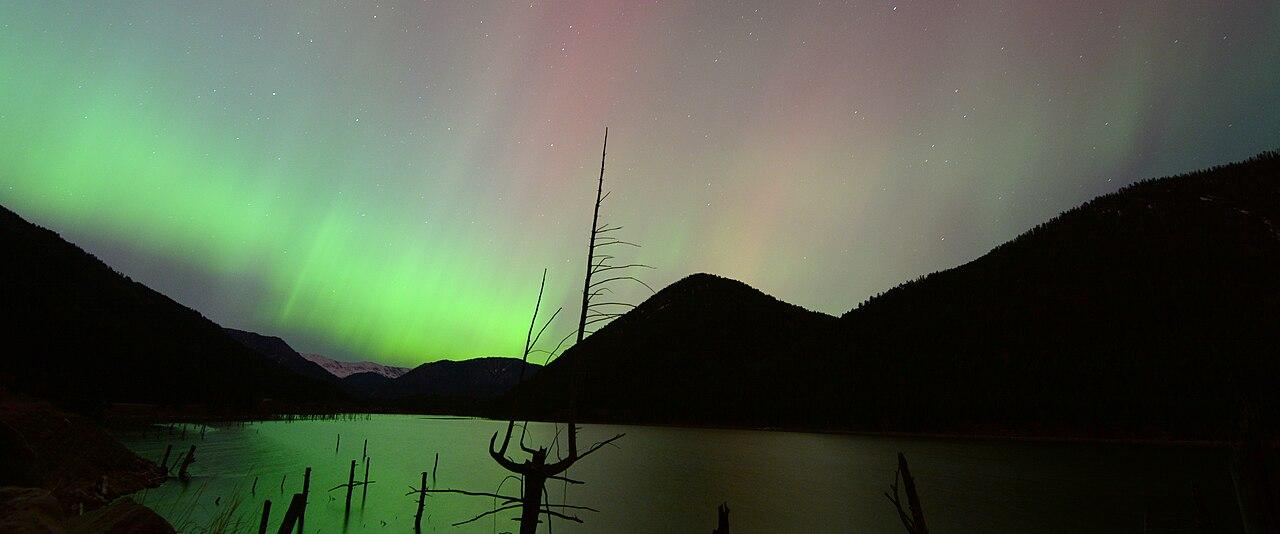
On the night of May 10, 2024, the strongest geomagnetic storm in more than twenty years turned the sky green and red across Montana. Viewers sent in photos from Great Falls, Arlee and Elk Park, and a Forest Service photographer caught the aurora over the drowned trees of Earthquake Lake. The lights came back in October 2024 and again in November 2025.
They don't come often, though. Montana sits at the southern edge of where the aurora usually reaches, and you need a strong storm, a dark site and a clear sky on the same night. This guide explains how strong a storm Montana needs, where in the state to watch, how to read the forecasts, and why 2026–27 is still a reasonable time to try even though the solar maximum has passed.
 The aurora over Earthquake Lake in the Custer Gallatin National Forest during the storm of May 10, 2024. Image: Forest Service - Northern Region, Public domain, via Wikimedia Commons.
How strong a storm Montana needs
The aurora forms an oval around the magnetic pole, and storms push it south. Space-weather forecasters measure storms on the Kp index, from 0 to 9, and NOAA's G-scale:
| Storm | Kp | NOAA says the aurora reaches | Per 11-year cycle |
|---|---|---|---|
| G1 minor | 5 | Northern Michigan, Maine | about 900 days |
| G2 moderate | 6 | New York, Idaho | about 360 days |
| G3 strong | 7 | Illinois, Oregon | about 130 days |
| G4 severe | 8 | Alabama, northern California | about 60 days |
| G5 extreme | 9 | Florida, southern Texas | about 4 storms |
For Montana, the official guidance varies by place:
- Glacier National Park tells photographers to look for Kp 5 or above with a clear forecast through the night.
- Yellowstone, in the far south, says it takes Kp 7 or more, and that the aurora shows there "once or twice a year".
- In between, the north of the state (the Hi-Line, Glacier, the Flathead) is the best placed. Bozeman and Billings generally need a stronger storm than Kalispell or Havre.
No official source counts how many aurora nights Montana gets a year, and most nights there is nothing to see.
What you will actually see
Cameras see more than eyes do. A long exposure records colour and detail that are too faint for your eye, so a weak display can look like a pale grey-white glow or faint pillars to the naked eye, and only turn green on a phone screen. In a strong storm like May 2024's, colours and moving curtains are plain to see. If you think you see a pale band low in the north, take a photo to check.
 A moderate display near Helena on October 7, 2024: faint to the eye, clearer on camera. Image: Montanabw, CC BY-SA 4.0, via Wikimedia Commons.
The solar cycle: past its peak, not finished
NASA and NOAA announced in October 2024 that the Sun had reached the maximum of its 11-year cycle. By early 2026 the UK Met Office described it as "in a declining phase", and on February 23, 2026 the Sun showed no sunspots for the first time since June 2022.
That doesn't mean the aurora is over. A NOAA space-weather scientist said in May 2026 that "some of the biggest solar storms in history have happened a year or two or three after the maximum sunspot number. We're not out of the woods yet." Montana's own record agrees: the May 2024 storm came months before the maximum was declared, and the G4 storm of November 11–12, 2025, which lit up skies across Montana, came a year after it. Expect fewer storms in 2026–27 than in 2024, but not none.
Where to watch in Montana
The rule is simple: get away from town lights and find a clear, low view to the north. Montana has three certified dark-sky places.
Waterton-Glacier International Dark Sky Park. Glacier and Canada's Waterton Lakes became the world's first cross-border dark sky park, provisionally in 2017 and fully in 2021. The park recommends Lake McDonald and the North Fork for their open views to the north. In winter the road is plowed only from West Glacier to Lake McDonald Lodge, so the foot of the lake at Apgar is the spot you can drive to all year. In summer, Glacier runs evening astronomy programmes at Apgar and St. Mary (usually July–August, no tickets needed), and the Dusty Star Observatory at the St. Mary Visitor Center has a 20-inch telescope.
 The aurora over the dock at Lake McDonald in April 2015. Image: GlacierNPS, Public domain, via Wikimedia Commons.
Medicine Rocks State Park, near Ekalaka in the south-east: Montana's first International Dark Sky Sanctuary, certified in December 2020. Day use ends at 10 p.m., so for the aurora you need one of its eight first-come campsites, open all year. The access road can become impassable after heavy rain.
Lost Trail National Wildlife Refuge, near Marion in the north-west: a dark sky sanctuary since October 2022. The refuge has no camping and its public hours are listed as sunrise to sunset, so ask the refuge before planning a night visit.
Other places Montana outdoor writers recommend include the Charles M. Russell National Wildlife Refuge and the Missouri Breaks in the east, Bannack State Park in the south-west, and Thompson Chain of Lakes State Park and the Flathead National Forest in the north-west. A north-facing lakeshore gives you both the sky and its reflection.
 An aurora arc reflected in Lake McDonald, Glacier National Park. Image: GlacierNPS, Public domain, via Wikimedia Commons.
How to know tonight's the night
- Three days ahead: check NOAA's 3-day forecast at spaceweather.gov for the predicted Kp in each three-hour block. Glacier also points to the University of Alaska Fairbanks aurora forecast.
- On the night: watch NOAA's 30-minute aurora forecast, based on solar wind measured 30 to 90 minutes before it reaches Earth. NOAA removed the "view line" from its tonight-and-tomorrow map in May 2026, so ignore older advice to check it.
- Check the clouds. In Montana, cloud cover ruins more aurora nights than weak storms do.
- Apps such as SpaceWeatherLive, My Aurora Forecast and Aurora Now send alerts when Kp rises.
Best time: NOAA says within an hour or two of midnight, 10 p.m. to 2 a.m. local time, though big storms can show from dusk. Best season: around the spring and autumn equinoxes; Montana's short summer nights make June and July hard. Avoid the full moon, which washes out faint displays. The coming new moons are November 9 and December 9, 2026, and January 7, February 6 and March 8, 2027.
Photographing it
The Park Service's night-photography advice works for the aurora:
- Use a tripod, or rest the camera on a car roof or a backpack.
- Shoot in manual mode at your lens's widest aperture (f/1.4–f/3.5), with 10–20 second exposures to keep stars sharp.
- Start around ISO 400 and raise it until the sky shows. Use a 2–5 second timer to avoid shaking the camera.
- On a phone, use night mode on the main lens and brace the phone.
- Put a mountain, a tree or a dock in the foreground.
- Use a red headlamp to keep your night vision.
Drones are banned in national parks.
 A clear dark sky over St. Mary on the east side of Glacier, part of the international dark sky park. Image: GlacierNPS, CC BY 2.0, via Wikimedia Commons.
Staying safe on a cold night
- Dress for standing still. The National Weather Service says exposed skin can freeze in 30 minutes at a wind chill of −19°F, which is 0°F with a 15 mph wind.
- Check roads on 511mt.net before driving to a dark site in winter. Keep the tank full and carry blankets, water, food and a shovel. The Beartooth Highway and other high passes are closed in winter.
- Remember the wildlife. In grizzly country, Yellowstone advises carrying "flashlights, some friends, and bear spray" after dark.
- The storm itself is harmless. Geomagnetic storms pose no health risk on the ground.
Information checked October 2026.